
15 Car Hire Scams and Tricks to Watch Out for in 2027
Hiring a car should be simple: book a car, pick it up, drive it and bring it back. But in a 2026 Which? survey of more than 3,600 people who had hired a car in the previous two years, one in eight said they’d paid more than the price they were first quoted.1
Not everything on this list is a scam. Some of it involves disputed or allegedly misleading charges. Some is aggressive selling at the desk. And some is a perfectly legitimate term in the contract that gets expensive because nobody pointed it out before you signed. Most car hires go without a hitch. This list is here so you can recognise and avoid problems when they happen, not six weeks later when a charge appears on your card.
The advice covers hiring cars in the UK and abroad. Where a rule or example is specific to one country or one company, we say so.
Jump to a section:
- The car you booked is suddenly unavailable
- You said no to the insurance. It’s on the bill anyway.
- The desk’s excess cover can cost more than the car
- You’ve got excess insurance. You still need to leave a big deposit.
- Paying by debit card? Be extra careful
- Got the wrong card? You may not get the car.
- The full tank you pay for but don’t get to use
- The £3.50 charge that can end up costing £138
- That scratch was already there. Now it’s apparently yours.
- The two-hour deadline hidden in the paperwork
- “Looks fine.” Then the bill arrives after you’ve flown home.
- The repair cost is only the start of the bill
- The AI scanner that finds damage no human saw
- The parking fine that comes with an admin fee
- Returning the car early could actually cost you more
The one rule that beats every item on this list
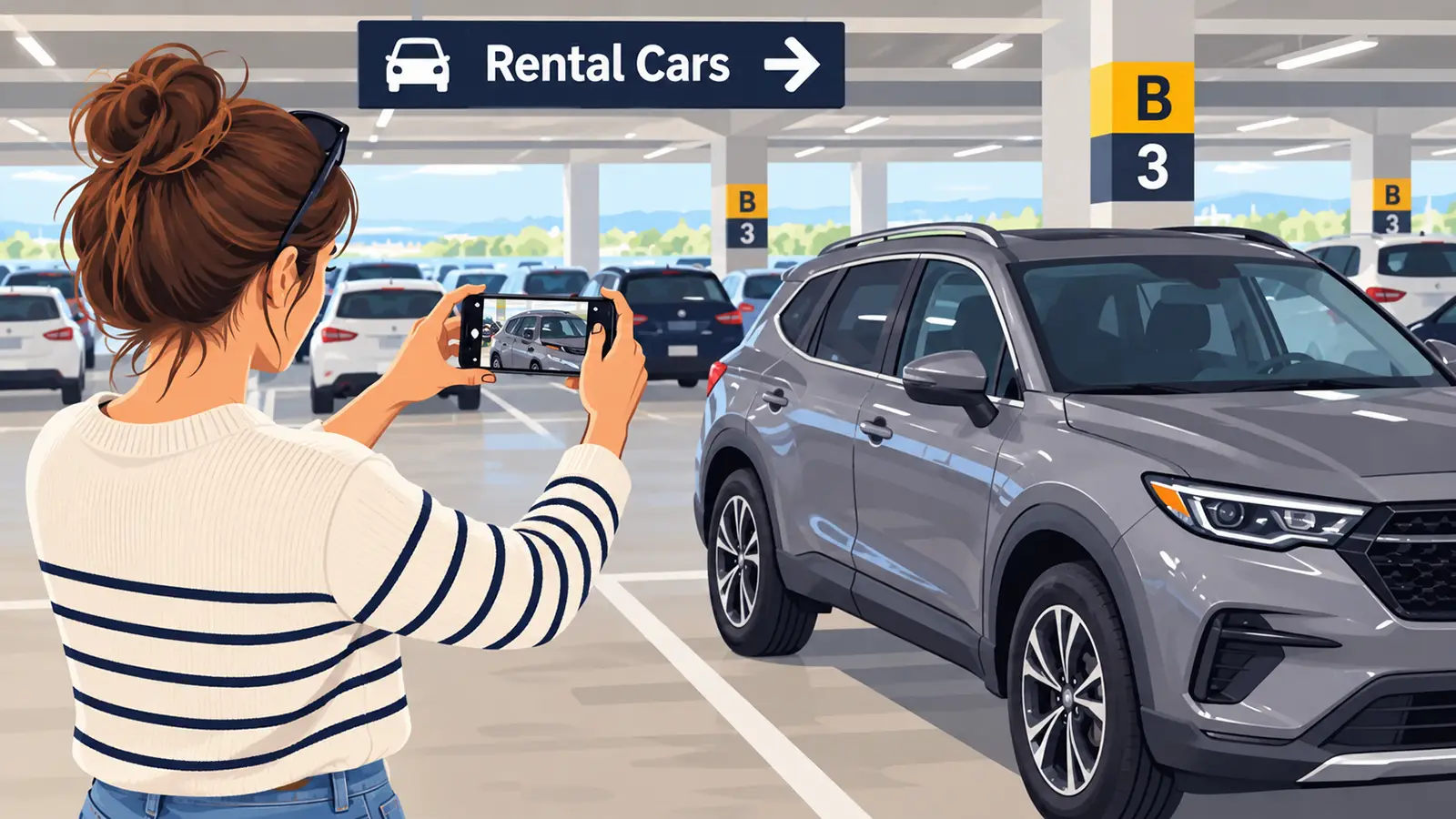
Take photos when you pick up the car. Take them again when you return it.
The second set matters more than people think. Once you’ve handed back the keys and walked away, you can’t go back and prove what condition the car was in. Photograph every panel, the wheels and alloys, the windscreen, the interior, and the dashboard showing mileage and fuel. Keep the rental agreement and your final fuel receipt too.
It takes about five minutes at the car park. If a charge turns up later, it’s the difference between “here’s my evidence” and your word against theirs. (This is the reason we built Rental Car Proof: an app that guides you through which photos to take and records the time and location with each one, so you’re not relying on your photo library.)
Now, the list.
2. You said no to the insurance. It’s on the bill anyway.
In 2024, Which? sent undercover researchers to car hire desks at Málaga and Alicante airports, all carrying their own car hire excess insurance. The researchers said staff at Goldcar, OK Mobility and Dollar told them things that weren’t true to persuade them to buy the company’s own cover.4
According to Which?, one Goldcar agent said the customer had “no protection, nothing… in case of damages, you pay everything”, even though basic damage cover was included. An OK Mobility agent said insurance “has to be with the car hire company”. A Dollar agent described the researcher’s own excess policy as “for nothing” and said the desk’s full cover “is always cheaper” than paying for any damage.4 Which? reported Goldcar and OK Mobility to the Competition and Markets Authority.5 Which? also says 61% of people who bought insurance at the desk said they had felt under pressure to do so.2
Pressure selling is one thing. Being charged for something you think you refused is another. In 2021 The Guardian reported the case of a Budget customer whose ten-day rental cost £110. He already had his own excess insurance, which had cost him £20, and said he declined Budget’s extra cover at the desk. He said he was then asked to sign two boxes on an otherwise blank iPad — and later found he had been charged more than £500 for premium insurance.6
That is his account. Budget told the paper it could not comment on what the agent did or didn’t say to him. It refunded half the charge as a goodwill gesture.6
Electronic signature pads make this easier to miss. You’re often shown a total on a screen, or just a box to sign, rather than the full itemised agreement.
What to do: Before you sign anything:
- Ask to see the full itemised agreement, not just a total.
- Check every optional line. Anything you declined should be marked as declined or show £0/€0.
- Check the grand total against your booking voucher.
- If you’re signing on a screen, ask for a copy by email or paper there and then, and read it before you drive away.
- Photograph the signed agreement.
If you’ve bought your own excess insurance, you don’t need to justify it at the desk. “No thank you, I have my own cover” is enough.
3. The desk’s excess cover can cost more than the car
Most car hire in the UK and Europe includes basic damage cover, usually called a collision damage waiver (CDW). But CDW normally leaves you with an excess — the amount you still pay if the car is damaged or stolen. That excess is often £1,000 or more.
The rental company will usually offer to reduce or remove that excess for a daily fee. The names vary (super CDW, excess waiver, “premium” or “relax” packages), and the price can be more than the hire itself. On one of Which?’s undercover visits, a Dollar agent quoted €162 for full cover on a rental that cost €136.5 In the same investigation, Which? found desk excess cover in Málaga averaged £177 a week, compared with £16 to £38 a week for standalone excess insurance.4
The gap is still large. Which?’s 2026 comparison found its top-rated standalone car hire excess policy cost £12 for a week in Spain, against £287 for Europcar’s own product.7
Standalone excess insurance (sometimes called excess reimbursement insurance) is bought separately, before you travel, from a specialist insurer. You can buy it per trip or annually. It’s much cheaper, but it works differently:
- Rental company cover usually reduces what the rental company can charge you in the first place. It often reduces the deposit too.
- Standalone cover doesn’t change anything at the desk. If there’s damage, the rental company charges you, and you claim the money back from your insurer.
Neither type always covers everything. Check the exclusions. One zero-excess product we’ve seen on a signed UK rental agreement still excluded wheels, tyres, glass, the roof, the underside of the car, the clutch and the interior.8
What to do: Decide before you travel, not at the desk. If you hire more than once a year, compare annual policies. Read what’s excluded — tyres, windscreens, keys and the underside of the car are common gaps — and check whether the policy covers the country you’re visiting.
4. You’ve got excess insurance. You still need to leave a big deposit.
This catches out a lot of people who’ve done everything right. You’ve bought standalone excess insurance, you decline the desk’s cover — and the rental company still blocks a large sum on your credit card.
That’s normal. Your insurance is a contract between you and your insurer. The rental company isn’t part of it, so it still wants security for its excess. Which? says that if you buy from a specialist insurer, “you’ll have to pay for any damage upfront and then claim it back”.7 In its 2024 investigation, Which? said companies typically blocked deposits of around £1,200 on the credit cards of customers who declined their insurance.5
Published terms show how much deposits vary. ClickRent in Spain lists deposits from €1,000 for its smallest cars to €2,000 for larger groups, falling to €200 if you buy its ClickRelax package.9 Europcar lists deposits of around £250 in the UK but €800 to €1,500 in France, Spain and Italy, depending on the vehicle.10
That’s also how the sale works at the desk: “Buy our cover and the deposit drops to almost nothing.” It’s a legitimate offer. It just isn’t the only way to hire the car.
What to do: Check the deposit amount for your supplier, pickup location and car category before you book. Some brokers show it clearly. Make sure your credit card has enough available credit for the deposit and the rest of your trip. The deposit is usually a pre-authorisation, so the money isn’t taken, but it isn’t available for you to spend either. Keep your excess policy documents handy in case you need to claim.
5. Paying by debit card? Be extra careful
Many British travellers don’t carry a credit card, or would rather not use one. A debit card can get you a hire car, but often on different terms, and there’s no single rule.
Some companies won’t accept a debit card for the deposit at all. Green Motion’s UK guidance says it needs “a master / visa credit card in the main drivers’ name”, and that debit cards aren’t accepted for the pre-authorisation.11 Sixt accepts debit cards in Great Britain, but the card must be in the main driver’s name, issued in your country of residence and presented in person. In Northern Ireland, Sixt says debit card customers paying a deposit must take its Top Cover protection. It also warns that “debit cards are not accepted everywhere”.12 ClickRent in Spain refuses Maestro and prepaid cards outright.9
Depending on the company, location, rate and car category, a debit card can mean:
- being refused the car;
- a larger deposit taken as a payment rather than a hold;
- being limited to certain vehicle categories;
- having to buy the company’s own protection package to hire the car at all.
That last one can be expensive. A Rental Car Proof user shared their paperwork from a UK airport branch of a budget brand in July 2026. The renter presented a debit card. The signed agreement shows the rental itself cost £89.83 — and a counter-sold excess-reduction product at £150 a day for six days, £1,080 including VAT. The company later told the customer this product was offered as an alternative so the hire could go ahead on a debit card, that its terms allow for this, and that the charge was non-refundable.13
That doesn’t make it a scam: the product was itemised on the agreement and the company says its terms disclose it. But the customer thought they were agreeing to something closer to a deposit. The lesson:
A deposit is money you expect back. A fee is money you’ve already spent.
What to do: If you plan to use a debit card, check the supplier’s terms for your pickup location before you book — not just the broker’s summary. If a desk offers an “alternative” to a credit-card deposit, ask: “Is this refundable?” Then check that the paperwork says the same.
6. Got the wrong card? You may not get the car.
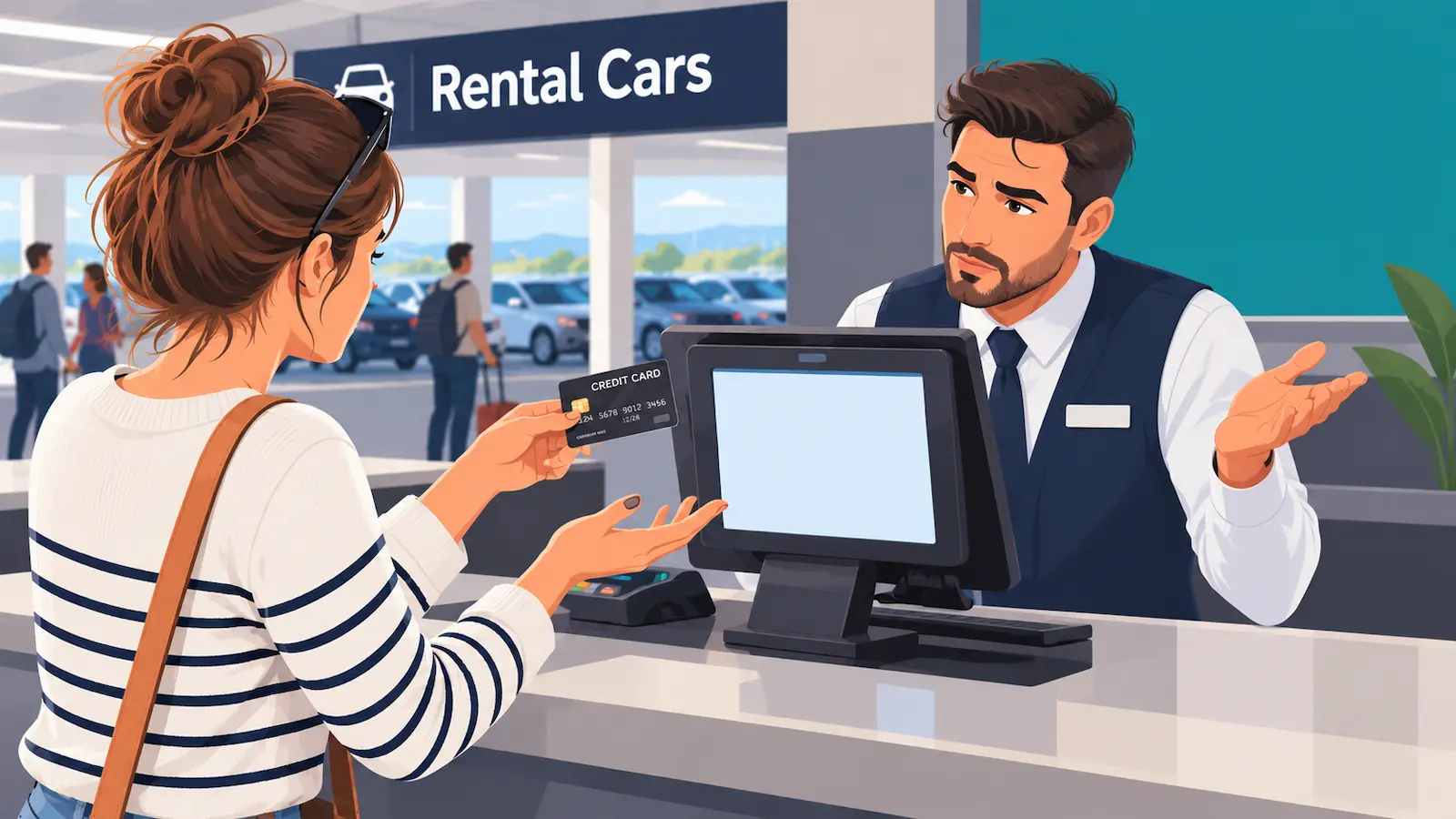
“I have a working card” doesn’t always mean “the rental company will accept my card”. A card that’s valid everywhere else can still fail the desk’s rules. There are several separate traps.
The name on the card. Many companies require the payment card to be in the main driver’s name. Green Motion’s UK guidance says it “cannot accept a credit card belonging to any other party”.11 Sixt also requires a card in the main driver’s name.12 Others are more flexible: ClickRent says the cardholder must be named on the contract as either the main or an additional driver.9 It varies, so check.
A physical card, not your phone. Some companies want to see the physical card. Sixt, for example, says that even if you paid for the booking with Apple Pay or PayPal, “a physical credit or debit card is also required at pick-up”.14
We came across exactly this problem at U-Save Stansted in 2026. The booking was in the main driver’s name, and the credit card was available in Google Wallet, but the physical card hadn’t been brought to the desk. Another person in the group had suitable physical cards, but because the booking and main-driver details were in someone else’s name, those cards couldn’t simply be substituted. The driver arrangements had to be changed, which meant paying an unexpected additional-driver fee of £20 per day.
It’s a good example of how a small detail can turn into an extra charge. If the company requires a physical card, having it on your phone may not be enough.
The expiry date. Your card can be perfectly valid and still be refused because it expires too soon. ClickRent in Spain requires the card to have more than four months left when you sign the rental agreement.9 Other companies can require even longer. In a September 2026 case examined by ADUC, an Italian consumer rights organisation, the rental terms required the customer’s credit card to remain valid for at least six months after the end of the rental. The customer was refused the car because their card didn’t meet that requirement.15
I ran into this myself when hiring from ClickRent in Spain: my card was still valid, but not for long enough, and I had to use a different one. There’s no standard rule — Sixt, for example, says the card must be valid at pickup and for the whole rental.12 So if your card expires within the next six months, check the supplier’s terms before you travel.
Available credit. The card needs enough available credit for the deposit. If a large hotel pre-authorisation is already sitting on the same card, the rental company’s hold may be declined.
The card type. Some companies exclude particular card networks or types. ClickRent, for example, excludes Amex, Diners, Maestro and prepaid cards.9
What to do: Before you travel, check:
- Credit or debit card accepted — for the deposit, not just the booking?
- Must it be a physical card?
- Must it be in the main driver’s name?
- How much available credit do you need?
- Is there a minimum period before the card expires?
- Are any card networks or types excluded?
Take the physical card with you — not just your phone. And if you can, take a second suitable physical card as a backup, especially when hiring abroad. And decide who the main driver is before you book, so the booking, the licence and the card all match. Adding a driver at the desk can cost extra.
7. The full tank you pay for but don’t get to use
You’re told you can bring the car back empty — you’ve already paid for a full tank.
With “full to empty” fuel policies, you pay upfront for a tank of fuel, often at a price above the local pump, plus in some cases a service fee. The European Consumer Centres Network says that under this type of policy “no refunds will be paid for unused fuel, even if the whole tank was paid for upfront”.16 Unless you manage to return the car on fumes, you’re paying for fuel you leave behind for the next customer. Which? recommends choosing companies with a “full to full” policy instead.2
Not every prepaid option works the same way. Some companies refund unused fuel. ClickRent’s “Quick Return” option does, but keeps a non-refundable €35 handling fee.9 Read what your option actually says.
Full to full isn’t free of charges either. If you return the car short on a full-to-full hire, ClickRent charges for the missing fuel plus a €35 “management and refuelling fee”.9 Other companies charge their own refuelling rate or fee.
What to do: Choose full to full where you can. Fill up at a petrol station close to the return point, keep the receipt, and photograph the fuel gauge and mileage when you drop the car off. If you do take a prepaid option, check whether unused fuel is refunded.
8. The £3.50 charge that can end up costing £138
Tolls aren’t the problem. The problem is what happens when a small toll goes unpaid and the rental company gets involved.
The Dartford Crossing is a good example. There are no barriers, so it’s easy to forget. For a car it costs £3.50, and you must pay by midnight the day after you cross.17 Miss it and a £70 penalty charge notice is issued — reduced to £35 if paid within 14 days, and increased to £105 if not paid on time.18 The penalty goes to the registered keeper — which, in a hire car, is the rental company.
Then the rental company’s administration fee is added. One renter described being charged a £68 “non-waiverable” admin fee by Green Motion in 2023 after a Dart Charge penalty — in that case, a penalty Dart Charge later admitted should never have been issued.19 A £68-per-notice admin charge also appears on U-Save paperwork we’ve seen from Gatwick in 2026.20 Smaller companies charge less: Practical Car & Van Rental’s Dartford branch charges £15 per undeclared crossing, on top of the toll.21
So at a company charging that £68 admin fee, a missed £3.50 crossing could leave you paying a £70 penalty plus £68 — £138 in total. Not every rental company charges £68; as above, some charge much less. And these are two different charges: the penalty comes from the toll authority, and the admin fee is the rental company’s contractual charge for dealing with it.
Abroad, the rules differ by country. In Portugal, many motorways use electronic tolls without booths. Hertz Portugal says an electronic toll service has been mandatory on its rentals since January 2023 under Portuguese law. It charges the tolls you use plus €2.21 a day, up to €22.14 per rental, and refunds the daily fee if you use no tolls.22 That’s a contractual charge, not a trick, but it’s worth knowing about before you get the bill.
What to do: Before you drive, ask whether the car has a toll tag, what it costs, and whether charges are per day, per toll or per rental. In the UK, pay the Dart Charge yourself online the same day, or check whether the hire company wants you to declare crossings instead. Keep a screenshot of the payment.
9. That scratch was already there. Now it’s apparently yours.
You’re charged for a scratch, dent, scuffed alloy or windscreen chip that you’re sure was already on the car when you picked it up.
This isn’t rare. Which? says 46% of people who told it they’d paid damage charges said the damage was already there when they picked up the car.2
Contract wording can put you at a disadvantage. One U-Save rental agreement we’ve seen makes the renter liable for damage “not noted on our vehicle check form… whether you were at fault or not”.20 Some UK agreements also have published damage thresholds, and some state there’s no allowance for fair wear and tear on a short hire. On the Green Motion form we’ve seen, scratches of 40mm or more and dents of 20mm or more count, as does any dent on the sill, roof or underside, and glass chips over 1mm.8 Those are small marks.
Without your own evidence, it comes down to your word against a condition sheet you probably signed in a hurry.
What to do: Don’t just photograph the damage you notice. Photograph the whole car, because you can’t predict which panel you’ll later need to prove was undamaged — or already damaged:
- every side and panel, close enough to see small marks;
- wheels and alloys;
- the windscreen, including small chips;
- the roof, where you can;
- the sills and lower edges of the bumpers;
- the interior and seats;
- the dashboard, showing mileage and fuel.
Make sure any existing damage is marked on the condition report before you drive away, and take your photos before you leave the car park.
Rental Car Proof walks you through each of these shots and records the time and location with every photo. It can’t guarantee a charge will be dropped, but it gives you a much clearer record if you need to dispute one.
11. “Looks fine.” Then the bill arrives after you’ve flown home.
You return the car. Someone glances at it and says it’s fine, or there’s nobody there at all. A week or a month later, a damage charge appears.
Which? found that 28% of Goldcar customers it surveyed said they’d been hit with additional charges, sometimes weeks after they’d returned home.1
Your pickup photos won’t help here. They show what the car looked like when you collected it, not what it looked like when you brought it back. For that, you need a second, complete set of photos at return.
Out-of-hours returns are especially risky. The European Consumer Centres Network warns that cars returned outside office hours are checked the following day, and that “consumers can be charged with damage at a later stage”.16
What to do, before you hand over the keys:
- Photograph every side of the car, the wheels, the windscreen and the interior — the same shots as at pickup.
- Get the mileage and fuel gauge in frame.
- Ask a member of staff to inspect the car with you and sign a return form confirming its condition and fuel level. The European Consumer Centres Network recommends this too.16 A verbal “you’re all good” isn’t a record.
- If you’re dropping off out of hours, take extra care. Photograph the car in the spot where you leave it, and the key drop.
If nobody inspects the car with you, your photos are the only record. That’s the gap Rental Car Proof was built to fill: a return inspection you do yourself, with the time and location recorded, whether or not anyone is there to watch.
12. The repair cost is only the start of the bill
When a damage charge does arrive, it’s often more than the cost of the repair.
Rental agreements commonly allow extra fees on top of the repair: a damage handling or appraisal fee, administration fees, and sometimes charges for the time the car is off the road. ClickRent, for example, lists a one-off €60 “damage appraisal cost”.9 During Which?’s 2024 investigation, a Dollar agent in Málaga told the researcher that scratches over 1cm would cost €300 to €400 each, “plus €50 admin fee, plus tax”. Which? estimated a typical scratch repair at around €250.5
As that per-scratch quote suggests, some companies charge from a set price list rather than an actual repair invoice. That isn’t necessarily unfair, but the amount you’re charged may not match what the repair actually cost.
The admin fee is often a separate line on the bill. In a case reported by The Guardian in 2015, Green Motion charged a customer £186 for damage, of which £48 was an administration fee. The customer disputed that he was responsible for the damage; Green Motion said the charge was justified and had been calculated using its damage price matrix.24 That’s an older case and says nothing about Green Motion’s prices today — but current terms, like ClickRent’s above, show that separate damage fees are still common.
What to do: If you receive a damage charge, ask for:
- an itemised breakdown (repair cost, admin fees and any other charges shown separately);
- the photos showing the damage, with the date they were taken;
- the condition reports from pickup and return;
- the repair invoice or estimate, or the price list they’ve used.
Then compare their photos with yours. If you have standalone excess insurance, check what it will reimburse. Some policies cover admin fees; others don’t.
13. The AI scanner that finds damage no human saw
This one is mainly happening in the US for now. But if you hire a car in America, you may come across it.
At some US airports, Hertz runs cars through automated scanning tunnels built by a company called UVeye. The system photographs the car at pickup and return and flags differences, without a human inspector.25 Hertz has said it plans to bring the technology to around 100 US airport locations.26
It’s been controversial. In August 2025, US Senator Richard Blumenthal wrote to Hertz citing a renter charged $195 for a dent that cost $80 to fix, and another charged $440 for what the letter called a minor scuff.27 CBS News reported the case of a Hertz customer billed $350 for two small dents — $80 of estimated repairs plus a $190 processing fee — which Hertz later waived.25 For balance: Hertz says more than 97% of the 675,000-plus rentals it had scanned showed no billable damage.25
We haven’t found evidence that Hertz has rolled out these scanners at its UK or European branches. UVeye does operate in the UK and Europe, and has said it’s expanding here, but its announcements don’t mention Hertz or rental desks in the UK.28
What to do: If you’re hiring at a US location that uses automated scanners, your own photos matter more, not less. An automated system comparing images is exactly the kind of claim where independent, time-stamped evidence helps.
14. The parking fine that comes with an admin fee
You get a parking ticket, drive into a restricted zone, or trigger a speed camera. The notice goes to the car’s owner — the rental company. It then passes on your details or pays the fine, and charges you an administration fee for doing so.
This can mean two separate bills:
- The fine itself, from the police, council or toll authority.
- The rental company’s administration fee for handling the notice or giving the authority your details.
The admin fee is not the fine. Paying one doesn’t mean you’ve paid the other.
Italy is the classic trap for British drivers. Many historic town centres are limited traffic zones (ZTLs) enforced by cameras. The European Consumer Centre in France explains that rental companies give your personal details to the police, who send the fine to your home, and that the rental company adds its own administrative charge, set in its terms and conditions. For drivers living outside Italy, the authorities have 360 days from receiving your details to notify you — which is why these fines can arrive many months after the holiday.29 Drive through the same camera more than once and you can receive more than one fine.
Admin fees vary a lot. ClickRent in Spain charges a €50 “fine management fee” per fine, which doesn’t include the fine.9 U-Save paperwork we’ve seen from Gatwick lists £68 per penalty charge notice,20 and at Practical Car & Van Rental’s Dartford branch it’s £15.21
What to do: Look up the admin fee for fines in your rental terms before you travel. In Italy, learn how ZTL signs look and ask your hotel whether you’ll need to drive into one. If you get a charge from the rental company, check what it’s for. If it’s an admin fee, expect the actual fine to follow separately.
15. Returning the car early could actually cost you more
It seems logical that bringing a car back early should cost less. It often won’t, and sometimes it costs more.
Many companies simply don’t refund unused days. Hertz UK’s terms say: “we are unable to give a refund if you return the vehicle early.” ClickRent’s say the same.309
The bigger risk is that changing your rental period can change the rate. Hertz UK’s terms say that any change to a booking “will be recalculated based on the availability and prices at the time the change is made”, which may be higher or lower than the original price.30
That’s what happened to Mike Howorth, whose case The Guardian reported in 2021. He booked a Hertz car for 28 days at £617 and returned it two days early. Hertz then added a £670 surcharge, taking the total to £1,288, because the special 28-day rate no longer applied and the rental had been recalculated. After the newspaper got involved, Hertz refunded the £670 as a goodwill gesture, while maintaining that its policy had been disclosed. The BVRLA told The Guardian that pricing based on the length of hire is common, but that possible changes should be made clear to customers.31
That doesn’t mean every early return costs more. It means that under some contracts, the price is tied to the length of hire you booked, and a shorter hire can land you on a more expensive rate.
Late returns have their own rules. Which? says late returns typically cost “an extra day’s hire, plus an admin fee”, and grace periods can be as short as 29 minutes.2
What to do: If your plans change, call the company or check the app and ask what the new price will be before you bring the car back early or late. Get the answer in writing.
If you’ve already been charged: where to complain
1. Complain to the rental company first. Do it in writing, include your photos, agreement and receipts, and ask for an itemised breakdown of the charge. Every route below expects you to have done this first. If you booked through a broker, send a copy to the broker too.
2. BVRLA Conciliation Service (UK hires). If the company is a member of the British Vehicle Rental and Leasing Association and you’ve been through its complaints procedure without a resolution, you can refer the dispute to the BVRLA. It reviews evidence from both sides against its Code of Conduct.32 It only covers BVRLA members.
3. European Car Rental Conciliation Service (hires elsewhere in Europe). The ECRCS handles cross-border complaints — for example, a UK resident hiring in Spain — but only against participating companies. The ECRCS lists Alamo, Avis Budget Europe, Budget Europe, Dollar Europe, Enterprise Europe, Europcar Europe, Firefly Europe, Hertz Europe, National, Sixt Europe and Thrifty Europe. It’s free. You must have received the company’s final response to your complaint, and you have 12 months from then to apply.3334 Many budget and local brands aren’t members.
4. Your card provider. If you paid by credit card and the cost was over £100 and up to £30,000, you may be able to make a Section 75 claim. For debit cards (or where Section 75 doesn’t apply) you can ask your bank for a chargeback.35 These routes aren’t automatic. Section 75 can be affected if you paid through a third party such as a broker. A chargeback is a card-scheme process rather than a legal right, and has time limits. Contact your card provider as soon as you can, and explain what you’re disputing and why.
None of this means your next hire will go wrong
Millions of people hire cars every year, return them and never think about it again. The point of this list isn’t to make you dread the desk. It’s that the desk is a bad place to find out about an expensive rule — and it’s much easier to spot a pushy upsell, a card problem or a questionable damage claim if you already know what they look like.
So: sort out your excess insurance and your card before you go. Read what you’re signing. Question anything on the bill that doesn’t add up. And take plenty of photos — especially when you return the car, because that’s the one moment you can’t go back and redo.
Rental Car Proof is built for exactly those few minutes: it guides you through the pickup and return photos and stores them with the time and location, ready if you ever need them.


Sources
- Which? — “One in eight car hire customers charged more than expected, as Which? reveals the best and worst rated firms” (30 June 2026). Survey of 3,637 adults who had hired a car in the previous two years, February–March 2026; 13% paid more than the price first quoted; 28% of Goldcar renters surveyed reported additional charges, sometimes weeks after returning home. ← ←
- Which? — “Avoiding car hire rip-offs in 2026” / Car hire scams — upgrade trick and Which?’s statement on the legal obligation in Europe; 46% of those who paid damage charges said damage was already present; 61% of desk insurance buyers felt pressured; full-to-empty fuel; late returns and 29-minute grace periods. Survey base for the 46% and 61% figures is not stated on the page. ← ← ← ← ←
- The Guardian — “Car hire firm told me I was a ‘no-show’ so I lost £185” (Anna Tims, 11 August 2026) — prepaid £185 Heathrow booking via Holiday Autos; flight number supplied; treated as no-show after delay; larger car at roughly double the price; Holiday Autos refunded the original rental plus upgrade and insurance costs. ←
- Which? — “Undercover Which? investigation catches car hire firms on camera using pressure tactics to rip off customers” (6 August 2024) — Málaga and Alicante airports; Goldcar, OK Mobility and Dollar; desk excess cover averaging £177 a week at Málaga vs £16–£38 a week for standalone policies. These are Which?’s findings from its visits; the companies’ responses are in the original article. ← ← ←
- Which? — “Car hire firms’ mis-selling and rip-off tactics exposed…again” (6 August 2024) — Dollar quote of €162 cover on a €136 rental; €300–€400 per scratch plus €50 admin fee plus tax; Which? repair estimate of around €250; typical deposits of around £1,200; referral of Goldcar and OK Mobility to the CMA. ← ← ← ←
- The Guardian — Budget £500 car hire insurance charge case (15 September 2021) — £110 ten-day rental; customer’s own £20 excess policy; customer’s account of signing two boxes on a blank iPad; more than £500 charged for premium insurance; Budget could not comment on what the agent said; half refunded as a goodwill gesture. The customer’s account, not a finding of mis-selling. ← ←
- Which? — “Best car hire excess insurance companies 2026” — top-rated policy £12 for a week in Spain vs £287 for Europcar’s own policy (prices checked March 2026); with specialist cover “you’ll have to pay for any damage upfront and then claim it back”. ← ←
- Green Motion, Manchester Airport — signed vehicle condition report and rental documents, July 2026, seen by Rental Car Proof (not published). Two-hour reporting window; damage thresholds; zero-excess product exclusions. Branch document; terms may vary by location. ← ← ←
- ClickRent — General Terms and Conditions (English PDF) — A.4 (no refund for early return); A.11 (nominative card; holder must be main or additional driver; expiry more than 4 months from signing); A.14 (Amex, Diners, Maestro and prepaid cards not accepted); B.2 (deposits by vehicle group; ClickRelax €200); D.2 (fine management €50/fine; damage appraisal €60); E.1–E.3 (fuel options and €35 fee). No version date on document; accessed 23 September 2026. ← ← ← ← ← ← ← ← ← ←
- Europcar UK — Deposit Policy — deposit amounts by country and vehicle type. ←
- Green Motion — “What do I need in order to hire a vehicle from a Green Motion location in the United Kingdom?” — Mastercard/Visa credit card in the main driver’s name; Amex, Diners, prepaid and debit cards not accepted for the pre-authorisation; no cards belonging to another party. ← ←
- Sixt UK — “Can I rent with SIXT without a credit card in the UK?” — debit card conditions in Great Britain; Top Cover LDW requirement for debit deposits in Northern Ireland; “debit cards are not accepted everywhere”. ← ← ←
- Rental Car Proof user — signed rental agreement and company email, UK airport branch, July 2026 (not published). ←
- Sixt — “Does SIXT accept Apple Pay, Google Pay, PayPal or prepaid cards?” — physical card in the main driver’s name required at pickup. ←
- ADUC — “Autonoleggio: mancato ritiro auto per carta di credito, spetta il rimborso?” (8 September 2026). Consumer was unable to collect a rental car at Catania Airport because the remaining validity of the credit card was less than six months. Although the consumer initially said the emailed terms did not mention this requirement, ADUC examined the supplied conditions and found that they explicitly required the card to remain valid for at least six months after the end of the rental period. ←
- European Consumer Centres Network — Car rental rights — fuel policies; inspecting the car with staff at return; out-of-hours returns. ← ← ←
- GOV.UK — Dartford Crossing charges — £3.50 for a car (one-off or pay-as-you-go); payment deadline midnight the day after crossing. ←
- GOV.UK — Dart Charge fines (penalty charge notices) — £70; £35 if paid within 14 days; £105 if not paid. ←
- MoneySavingExpert Forum — “Incorrectly chased for ‘admin fee’ from car hire company — do I pay?” (September 2023) — one renter’s account of a £68 Green Motion admin fee after a Dart Charge penalty. A forum account, not verified. ←
- U-Save, Gatwick — signed rental agreement and condition report, June 2026, seen by Rental Car Proof (not published). Clause 3(f); “true record” wording; two-hour reporting window; £68 admin fee per penalty charge notice. Branch document; terms may vary by location. ← ← ← ← ←
- Practical Car & Van Rental, Dartford — Terms and Conditions — £15 per undeclared Dartford crossing plus the charge; £15 administration fee for fines. ← ←
- Hertz Portugal — “Mandatory e-Toll service (Via Verde) for renting a car” — mandatory under Decree-law 84-C/2022 from 8 January 2023; €2.21 a day up to €22.14 per rental; refunded if unused. ←
- Sixt UK — “How do I report damage that was already there at pickup?” — one-hour window via app or WhatsApp/SMS link. ←
- The Guardian — Green Motion damage charge case (31 October 2015) — £186 damage charge including a £48 administration fee; customer disputed responsibility; Green Motion said the charge was justified and calculated using its damage price matrix. Older case; not evidence of current prices. ←
- CBS News — “Behind the controversial AI tech used to inspect rental vehicles for damages” (26 August 2025). ← ← ←
- Your Mileage May Vary — “Worried about Hertz’s AI damage scanners? Where you rent matters most” (30 March 2026) — Hertz plan for roughly 100 US airport locations. ←
- US Sen. Richard Blumenthal — letter to Hertz about AI rental-car inspections (August 2025). Examples cited in a letter, not findings. ←
- PR Newswire — “UVeye expands in UK and Europe” (1 July 2025) — UK/EU expansion; Hertz not mentioned. ←
- European Consumer Centre France — Traffic fines in restricted areas in Italy (ZTL) (updated 5 May 2026) — rental companies pass on renters’ details; separate administrative charge; 360-day notification limit for non-residents. ←
- Hertz UK — Rental Terms — no refund for early return; booking changes recalculated at current prices. ← ←
- The Guardian — Hertz early-return case (13 November 2021) — Mike Howorth; 28-day Hertz rental at £617; returned two days early; £670 surcharge, total £1,288; Hertz refunded £670 as a goodwill gesture while maintaining the policy was disclosed; BVRLA comment on duration-based pricing and disclosure. ←
- BVRLA — Making a complaint (ADR) — for complaints against BVRLA members after the member’s complaints procedure is exhausted. ←
- European Car Rental Conciliation Service — FAQs — participating companies; cross-border rentals; free; 12 months from the company’s final decision. ←
- Chartered Trading Standards Institute — European Car Rental Conciliation Service (ECRCS) — UK-approved ADR body; countries covered; consumer must contact the trader first. ←
- Citizens Advice — Getting your money back if you paid by card or PayPal — Section 75 (£100–£30,000) and chargeback. ←